



I’ve tested more nootropics than I can count — from capsule stacks like Mind Lab Pro and Hunter Focus to liquid shots like Magic Mind.
At this point, I’ve learned to be skeptical of any supplement that promises “limitless focus” or “instant creativity.” Still, I get why these products attract so much attention. When you’re running on broken sleep, trying to train, work, and raise kids, that mental edge matters.
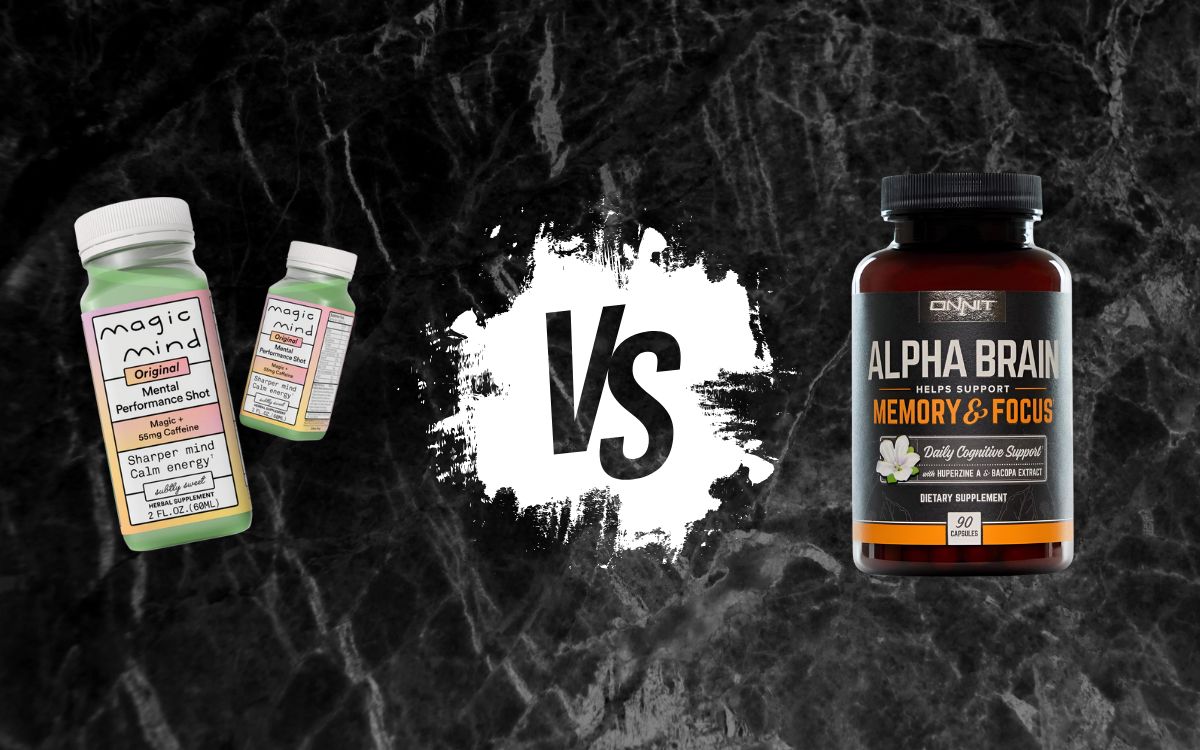
Two big names in the sphere are Magic Mind and Alpha Brain. Both claim to improve focus, reduce stress, and enhance creativity, but their approaches differ.
Magic Mind is a matcha-based, ready-to-drink shot loaded with adaptogens and mild nootropics, while Alpha Brain is a capsule formula built around cholinergic compounds and botanical extracts.
I’ve used both at different times over the past couple of years, running them through the same testing protocol I use for all cognitive enhancers: real-life conditions, consistent tracking, and honest reflection.
Quick Verdict
Magic Mind delivers clean, sustained energy and sharper focus without the caffeine crash, but the issue I have with it is the proprietary blend and premium pricing; you’re paying luxury rates for convenience and branding rather than full transparency.
Alpha Brain, on the other hand, feels more traditional with its capsule-based, stimulant-free form, with a heavy emphasis on acetylcholine support and alpha brainwave production. It’s one of the few mainstream nootropics with an actual clinical study behind it, though its undisclosed blend doses and inconsistent results keep it from being a clear winner.
If you forced me to choose between these two, Magic Mind gives a more noticeable “feel” you can actually detect. Alpha Brain’s effects are more subtle and often hit-or-miss.
That said, neither ranks among my top recommendations today. For serious cognitive enhancement at a better value and full transparency, Mind Lab Pro and NooCube remain the smarter long-term picks.

Winner
Based on my experience with each nootropic supplement, neither Magic Mind nor Alpha Brain hold a light to Mind Lab Pro.
Mind Lab Pro has 3 clinical studies backing its formula and is a non-stimulant nootropric to enhance short and long-term brain function.
What Is Magic Mind?
Magic Mind was launched in 2020 by entrepreneur James Beshara, who created it after a caffeine-related health scare. The idea was to replace the roller coaster of coffee with a cleaner, more sustainable form of energy.
What came out of that journey is a 2-ounce “mental performance shot” — a blend of matcha, nootropics, adaptogens, and vitamins in a small, drinkable bottle.
It comes in three formulas:
- Original (55 mg natural caffeine)
- MAXX (165 mg caffeine)
- FREE (caffeine-free)
Each shot combines ingredients like Ashwagandha, Bacopa Monnieri, Citicoline, Rhodiola Rosea, Lion’s Mane, and Cordyceps, plus ceremonial-grade matcha for a natural caffeine + L-theanine combo. The company claims nano-encapsulation improves bioavailability, though no third-party data confirms this.
The blend totals 6.26 grams, which is a substantial amount, but exact dosages per ingredient are hidden behind a proprietary “Nulixir” blend, which is frustrating given the $5–6 per serving cost.
Still, it’s one of the few liquid nootropics that doesn’t rely on sugar or synthetic caffeine to deliver results. It’s marketed to entrepreneurs, athletes, and creators, all people who need sustained mental performance and stress resilience.
You can read my Magic Mind review for my experience taking this nootropic.
Pros
- Clean, calm focus without crashes
- Noticeable stress reduction from Ashwagandha and Rhodiola
- High-quality ingredients like Cognizin® and fruiting-body Lion’s Mane
- Ready-to-drink format for convenience
- Effective replacement for morning coffee
- Works well under real-world stress (training, parenting, deadlines)
Cons
- Proprietary blend hides individual dosages
- Premium pricing ($178.50 single, ~$98 with sub)
- Acquired taste — earthy, bitter, very “green”
- Plastic waste from daily bottles
- May cause mild digestive issues for some users
What Is Alpha Brain?
Alpha Brain is the flagship nootropic from Onnit Labs, the supplement and fitness brand co-founded by Aubrey Marcus and famously backed by Joe Rogan. It’s marketed as a stimulant-free cognitive enhancer that helps you get “in the zone” by promoting focus, memory, and mental clarity through improved neurotransmitter activity and alpha wave production.
Alpha Brain’s formula centers around three proprietary blends:
- Onni Flow Blend (Cat’s Claw, Oat Straw, L-Theanine)
- Focus Blend (Alpha GPC, Bacopa Monnieri, Huperzia Serrata)
- Fuel Blend (L-Tyrosine, L-Leucine, Pterostilbene)
This combination aims to increase acetylcholine levels and optimize brainwave patterns associated with flow states. It’s caffeine-free and relies on amino acids, herbal extracts, and cholinergic precursors rather than stimulants.
While Alpha Brain has a peer-reviewed clinical study (funded by Onnit) showing improvements in delayed verbal recall and executive function after six weeks, results are mixed in the real world. Many users, myself included, find the effects subtle at best. Others swear by it for mental sharpness without jitters.
The biggest issue remains the same as Magic Mind’s: the proprietary blends make it impossible to verify whether ingredients are dosed effectively. That said, Alpha Brain’s capsule format and lower cost make it more accessible for long-term use.
You can read my Alpha Brain review for my experience taking this nootropic.
Pros
- Clinically studied formula (double-blind, placebo-controlled)
- Caffeine-free — no crash or sleep disruption
- Solid ingredient base: Alpha GPC, Huperzine A, Bacopa, L-Theanine
- Trusted brand with wide availability
- Good entry point for nootropic beginners
Cons
- Proprietary blends hide ingredient dosages
- Mixed real-world results — some users feel nothing
- Occasional reports of headaches or nausea
- Study was funded by Onnit (possible bias)
- Effects are mild compared to premium nootropics
Magic Mind vs Alpha Brain: Main Differences
Benefits
Both products aim to improve focus, mental clarity, and cognitive endurance, but the way those benefits show up day-to-day is what separates them.
Magic Mind provides a blend of calm alertness and mental steadiness that builds across the day rather than hitting all at once. It doesn’t deliver a “kick” like caffeine or a pre-workout; it’s smoother, more grounded — the kind of focus you notice when you’re deep into a task and realize you haven’t checked your phone for an hour. The combination of matcha caffeine, L-theanine, andadaptogens creates what feels like a productive, low-stress flow state.
What impressed me most was howresilient that focus felt. Whether I was programming workouts, editing video, or wrangling two kids after training, I had more patience and fewer mental crashes. The adaptogenic backbone, coming mainly from Ashwagandha and Rhodiola, clearly helps modulate stress responses and smooth energy levels throughout the day.
Alpha Brain tries to achieve cognitive sharpness through a different mechanism by enhancing neurotransmitters, specifically acetylcholine and dopamine, and promoting alpha brainwave production, which is associated with creativity and mental flow. In theory, this should translate to better verbal recall, multitasking, and problem-solving.
In practice, I found the effects subtler. It doesn’t give any noticeable energy boost, which is good if you’re caffeine-sensitive, but the “focus” feels more like an occasional clarity spike rather than a consistent lift. After a few weeks, there were small improvements in verbal recall, but not enough to move the needle in real-world performance.
Ingredients
Magic Mind Ingredients
Magic Mind uses a 6.26g proprietary blend, which is massive by supplement standards. That’s both a blessing and a curse.
The downside is that it hides exact dosages, which means you can’t verify whether every compound reaches clinically effective levels.
The upside is that with 6.26 grams to work with, it can contain meaningful doses of several key ingredients, something most proprietary blends can’t claim.
Let’s break it down.
Ceremonial-Grade Matcha (Leaf):
Provides around 55 mg of natural caffeine in the Original version (roughly half a cup of coffee), combined with L-theanine, which promotes calm focus and smoother energy curves.
Clinical research supports this combo: about 100 mg caffeine + 200 mg L-theanine improves attention and reduces mental fatigue. While Magic Mind’s ratio is likely smaller, it still sits within an effective window for daily clarity without overstimulation.
Cognizin Citicoline:
A standout ingredient and one of the most effective brain-energy boosters available. Citicoline supports phospholipid synthesis and boosts acetylcholine production.
Studies show significant cognitive improvements at 250–500 mg daily, especially in memory and processing speed.
Since this ingredient is expensive, and Magic Mind highlights it by name, it’s likely included in that effective range. This alone adds serious credibility to the formula.
Ashwagandha (Root):
The adaptogenic workhorse. Backed by strong clinical data at 300–600 mg daily, Ashwagandha lowers cortisol, enhances calmness, and can improve cognitive resilience under stress.
Given the total blend size, Magic Mind probably delivers a functional dose close to 300–400 mg, enough to feel a real difference in stress tolerance after a week of consistent use.
Bacopa Monnieri (Whole Herb):
A classic memory enhancer used in numerous clinical trials, typically dosed at 300–450 mg daily of extract standardized to 20–24% bacosides.
Magic Mind uses “whole herb,” which may be less concentrated, but again, with 6.26 g of total blend space, there’s likely room for a useful amount. Bacopa takes weeks to build up, which aligns with the gradual cognitive improvements I experienced.
Rhodiola Rosea (Root):
Another adaptogen with decades of research behind it. Effective doses typically range from 200–400 mg, standardized for rosavins and salidrosides.
When dosed properly, Rhodiola helps fight fatigue, boost mood, and improve performance under stress. Combined with Ashwagandha, it creates a synergistic stress-buffering effect.
Lion’s Mane (Fruiting Body):
One of the more exciting ingredients in modern nootropics. Studies suggest that 500–1000 mg daily of fruiting-body extract can promote nerve growth factor (NGF) production, improving focus and long-term cognitive health.
Magic Mind specifies “fruiting body,” not “mycelium,” which is crucial and means the high-value part of the mushroom is used.
Cordyceps:
Traditionally used for energy, endurance, and oxygen utilization. Research indicates 1000–3000 mg daily is optimal for performance, though Magic Mind probably includes around 500–800 mg. Enough for a mild energy boost, not athletic-level enhancement.
Turmeric (Root):
Turmeric’s curcumin component supports brain and joint health, but it’s poorly absorbed without piperine (black pepper extract). Magic Mind doesn’t list piperine, which limits its bioavailability. Still, its anti-inflammatory properties contribute modestly to brain health.
L-Theanine:
Found naturally in matcha, but also likely added separately for a precise caffeine-to-theanine ratio. Ideal dosing is around 200 mg, promoting calm focus and balancing caffeine’s effects.
Final thoughts on Magic Mind’s formula:
Despite the opaque blend, the sheer total weight (6.26g) gives confidence that several ingredients are dosed effectively. You’re not getting micrograms of herbs for label decoration; you’re likely getting several hundred milligrams of real actives per shot.
Still, for a product at this price point, I’d love to see full disclosure. Transparency is the standard for serious nootropic brands in 2025, and Magic Mind should meet it.
Alpha Brain Ingredients
Alpha Brain divides its formula into three proprietary blends, totaling just 1.2 grams combined or a fraction of Magic Mind’s payload.
That makes its lack of transparency harder to forgive. Each blend likely underdoses most compounds compared to their clinical ranges.
Here’s what’s inside those blends:
Onni Flow Blend (350 mg total): Combines Cat’s Claw, Oat Straw, and L-Theanine
These ingredients have some evidence for mental clarity and antioxidant support, but the total amount is too low for meaningful effects. Cat’s Claw, for instance, is typically studied at 250–350 mg alone, leaving little room for the others.
Focus Blend (240 mg total): Contains Alpha GPC, Bacopa Monnieri, and Huperzia Serrata.
Alpha GPC works best around 300–600 mg, improving acetylcholine and cognitive speed. Here, it’s likely below 150 mg.
Bacopa again needs 300 mg+ for effect, but Alpha Brain’s total blend size makes that impossible.
Huperzia Serrata delivers Huperzine A, effective at 100–200 mcg, but high doses can cause headaches and overstimulation.
Fuel Blend (60 mg total): L-Tyrosine, L-Leucine, and Pterostilbene are meant to support dopamine and antioxidant function.
Unfortunately, the blend is far too small for meaningful levels. L-Tyrosine alone is typically dosed around 500–2000 mg in clinical studies for focus and stress resilience.
Final thoughts on Alpha Brain’s formula:
While Alpha Brain contains several good ingredients in theory, the total active material is simply too low. With only about a gram of active compounds across three blends, there’s no way it can match clinically effective doses.
Add to that the reliance on outdated proprietary labeling, and you end up with a formula that looks strong on paper but underwhelms in real use.
Short vs. Long-Term Effects
Magic Mind starts working quickly, and within 30–45 minutes, you’ll feel smoother energy and clearer focus. The liquid format likely improves absorption, and the small caffeine + L-theanine combo enhances alertness without the edgy intensity of coffee. After about a week, adaptogens like Ashwagandha and Rhodiola start layering in deeper calmness and better stress management.
After 2–3 weeks, I noticed consistent cognitive steadiness: better task-switching, fewer mental dips after lunch, and improved creative output during writing sessions. That aligns with how adaptogens typically build up over time.
Alpha Brain, being stimulant-free, doesn’t have that instant “feel.” You might notice mild mental clarity after a few days, but the most reliable improvements, if any, appear after several weeks. Even then, they’re modest. It’s more of a background enhancer than an energy or focus tool.
So, while Alpha Brain plays the long game, Magic Mind gives bothimmediate and cumulative effects.
Clinical Research
Alpha Brain takes the lead here by being one of the few nootropics with a published, peer-reviewed study on its complete formulation.
That six-week study showed improvements in delayed verbal recall and executive function. However, the trial was funded by Onnit, so there’s always the question of bias.
Magic Mind doesn’t have a study on its full formula yet, though most of its ingredients are backed by dozens of independent clinical trials individually.
Side Effects
Both products are relatively safe, but tolerance varies.
SomeMagic Mind users experience mild digestive issues, particularly when taken on an empty stomach. Others report nausea or stomach cramps from the herbal concentration. I avoided these by taking it after breakfast.
The MAXX version’s higher caffeine dose (165 mg) can cause jitters or sleep disruption if taken late, but the Original is balanced enough for daily use.
Because of Huperzine A and Alpha GPC are a part of Alpha Brain’s formulation, headaches and nausea are the main possible complaints. These compounds elevate acetylcholine, which can cause tension headaches in some people.
If you’re sensitive to choline or already consume eggs or fish oil regularly, Alpha Brain can push you over the threshold.
Neither causes dependency or withdrawal symptoms and both can be cycled easily.
Availability
Magic Mind is direct-to-consumer, available primarily through its official website and Amazon. The subscription model is pushed aggressively through discounts of 45–50% off for recurring orders, which is good savings if you plan on consistent use, but slightly manipulative in presentation.
Alpha Brain is everywhere — Onnit’s official store, Amazon, GNC, Vitamin Shoppe, and even major e-commerce sites. You can find both the classic and “Alpha Brain Black Label” (a premium version with caffeine) widely stocked.
User Reviews
Magic Mind has over 60% of reviews that are positive, praising the energy stability, calm focus, and reduced caffeine reliance. Many mention decreased stress, improved creativity, and better productivity without crashes.
Negative reviews focus mostly on the taste (“earthy,” “bitter”) and price, as well as occasional digestive side effects.
Alpha Brain:
With tens of thousands of reviews, it averages around 4.3 stars on Amazon but closer to 3.5 on Onnit’s own site. Many users report mild improvements in clarity or memory but nothing dramatic. Others say they felt no change at all, suggesting either underdosing or high individual variability.
Overall, Magic Mind inspires stronger reactions — both positive and
Lawsuits
Only Onnit Labs has been hit with legal scrutiny. In 2015, the company faced a class-action lawsuit claiming false advertising about Alpha Brain’s cognitive effects. The case was settled without Onnit admitting fault, and the formula has since been updated.
Magic Mind, to date, has had no legal disputes or FDA warnings, keeping a clean record in its few years on the market.
Price
| Product | Format | Single Purchase | Subscription / Multi-Pack | Cost per Serving |
| Magic Mind (Original) | 30 shots | $178.50 | ~$98 (with sub) | $3.27 |
| Magic Mind (MAXX) | 30 shots | $193.50 | ~$106 (with sub) | $3.53 |
| Alpha Brain | 45 capsules | $79.95 | $67.96 (with sub) | $1.51 |
At roughly $100–$190 per month, Magic Mind sits in luxury territory — you’re paying for convenience, ingredient quality, and brand positioning. Alpha Brain, at about $68/month with subscription, is more affordable but also weaker in impact.
If you compare value per performance, Mind Lab Pro still outperforms both, delivering fully disclosed clinical doses at $69/month.
My Experience With Magic Mind and Alpha Brain
I’ve used both Magic Mind and Alpha Brain at different points — not side by side, but each for several weeks under the same conditions: busy schedule, early workouts, late nights editing, and the constant background chaos of family life.
Magic Mind was the one I actually felt working. The taste was rough at first — bitter matcha with an herbal afterbite, but the effect made up for it.
Within 30–40 minutes, I’d get a clean lift in energy and focus without the edge or crash of coffee. I could sit down, write, or plan training sessions and stay there without bouncing between tabs or caffeine-induced distraction loops.
The difference was subtle but obvious enough to notice every morning.
Over time, I started realizing how much calmer I felt when things got hectic. The usual irritability that comes with too little sleep and too many tasks softened.
I can’t say i was more energetic, just more steady. That’s what adaptogens like Ashwagandha and Rhodiola are supposed to do, and in Magic Mind, they actually seemed to deliver.
Even my training sessions benefited because I could focus on the lift itself instead of letting fatigue or scattered thoughts pull me off track.
Alpha Brain, by comparison, felt like the opposite. No taste, no energy, no obvious kick, and not much else either. I kept waiting for some moment where my focus sharpened or recall improved, but it never really came.
The formula looks decent on paper, and the clinical study gave me hope, but in practice, the results were too mild to register. I didn’t feel worse on it, but I didn’t feel any sharper either. It’s one of those supplements you want to believe in more than you actually experience.
Between the two, the difference is night and day. Magic Mind gave me tangible focus, less stress, and a smoother day. Alpha Brain didn’t move the needle.
I’ll give Onnit credit for at least trying to back their formula with research, but from a real-world standpoint, the effects just didn’t match the hype.
Should You Take Magic Mind or Alpha Brain?
If you want something that you can actually feel working, go with Magic Mind. It’s fast-acting, clean, and noticeably improves focus, mood, and patience without overstimulation.
The matcha-based caffeine gives you steady alertness, and the adaptogens smooth out the stress that normally follows long workdays or chaotic mornings.
It’s ideal for entrepreneurs, creators, or parents juggling multiple responsibilities who want a natural upgrade to coffee.
The downsides are obvious — it’s expensive, the proprietary blend hides dosing, and the taste isn’t exactly pleasant. But if you can afford it and value convenience, it’s one of the few functional nootropics that lives up to its claims.
Alpha Brain makes sense only if you’re highly caffeine-sensitive or prefer a stimulant-free capsule for gradual cognitive support. It’s easy to tolerate and technically has a published study behind it, but in practice, the effects are mild.
You might notice slightly better recall or mental clarity after a few weeks, but it won’t change your day-to-day performance. For most people, it’s simply not strong enough to justify the price.
If you’re new to nootropics or want something with transparent dosing and proven long-term results, skip both and try Mind Lab Pro. It offers clinical-level ingredient dosages, clear labeling, and consistent results without the premium marketing markup.
Mind Lab Pro
Mind Lab Pro Nootropic Brain Supplement
Non-Stimulant Nootropic For Instant Brain Boost
Boost brain power & reduce cognitive decline.
CHECK CURRENT DEALS
