

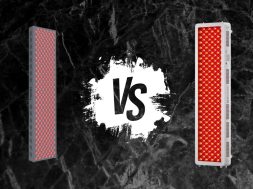


I’ve tested a lot of red light therapy panels over the years, and the budget end of the market has gotten more competitive. BestQool and Hooga are two of the most searched names in that space, and I ran both through several weeks of real training use to find out which one is worth your money.
BestQool recently upgraded their flagship to the Pro200, a four-wavelength panel with clinical-grade irradiance claims. Hooga has been the budget benchmark for a while, and their HGPRO450 is their current best panel.
Both devices target the same buyer: someone who wants real red light therapy results without paying premium brand prices. One of them delivers on that promise better than the other.
Quick Verdict
BestQool Pro200 wins this comparison on raw specs: four wavelengths versus two, and significantly higher irradiance output. Hooga is the better budget starter device for skin-only goals. Neither matches the RLT Home TotalSpectrum Compact, which delivers seven wavelengths, verified third-party irradiance data, and better build quality at a competitive price point.
Quick Verdict
BestQool edges Hooga on wavelength count and irradiance, but the gap to a truly clinical-grade device is still real. The RLT Home TotalSpectrum Compact covers 630nm, 660nm, 810nm, 830nm, 850nm, 940nm, and 1070nm in a single panel.
For the serious athlete or anyone who wants their red light therapy to actually move the needle on recovery and pain, the TotalSpectrum Compact is the device that belongs in your routine.
Both BestQool and Hooga are reasonable entry points. But if you are ready to invest in something that performs at a clinical level, the RLT Home TotalSpectrum Compact is the clear upgrade.
What Is BestQool Pro200?
BestQool is a Chinese consumer electronics brand that has been steadily improving its red light therapy lineup. The Pro200 is their current flagship panel, positioned above the budget BQ series.
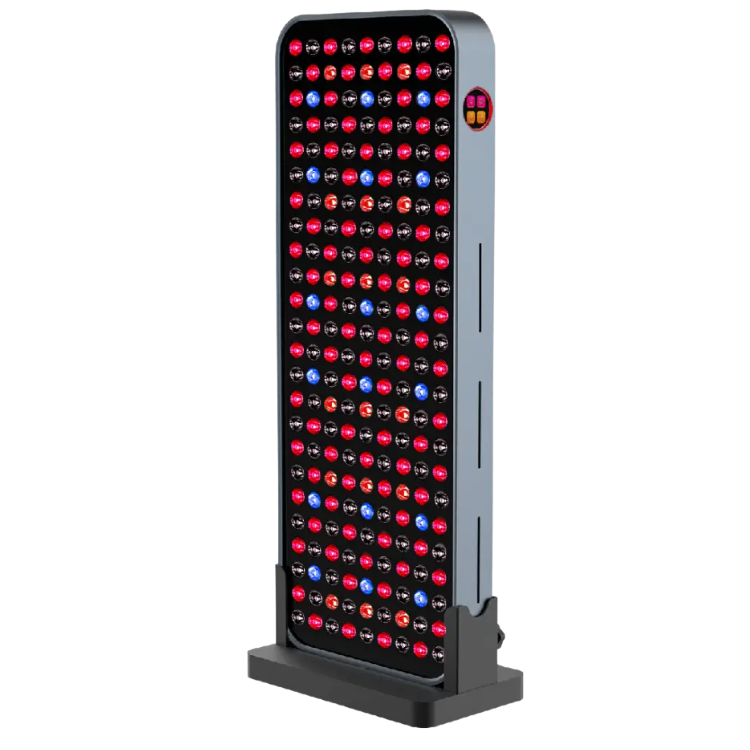
The Pro200 runs 200 dual-chip LEDs across four wavelengths: 630nm, 660nm, 850nm, and 940nm. It draws 340W and claims irradiance above 111 mW/cm² at three inches.
At 36.8 inches tall, it covers full-body treatment in a single session. Two panels can be linked side by side for wider coverage.
The build is functional but not premium. The cooling fans are audible, and the housing is plastic-framed. For the price, the specs are strong.
Pros
- Four wavelengths covering red and near-infrared ranges
- Clinical-grade irradiance claim at over 111 mW/cm²
- Full-body panel height at 36.8 inches
- Separate RED/NIR controls and built-in timer
- Modular design: panels link side by side
- Competitive price at around $589
Cons
- No published independent third-party irradiance verification
- Plastic housing feels functional rather than premium
- Audible cooling fans during sessions
- Limited brand track record compared to established names
My BestQool Pro200 review covers my full experience with this device.
What Is Hooga?
Hooga is one of the most recognized budget red light therapy brands on Amazon. They have sold thousands of units to first-time buyers looking for an affordable entry into the space.
The HGPRO450 is their current best panel. It runs 450 LEDs across 660nm and 850nm, with a published irradiance of around 100 mW/cm² at two inches.
Hooga does publish third-party irradiance test data, which is a meaningful advantage over many competitors at this price. The panel is solid for skin work and light recovery use.
The build quality is plastic-based but durable for daily home use. Customer support is generally responsive based on publicly available reviews.
Pros
- Published third-party irradiance testing
- Affordable price point starting under $300
- Good for skin improvement and casual recovery use
- Wide availability and consistent customer support
- Lightweight and easy to mount
Cons
- Only two wavelengths: 660nm and 850nm
- Lower irradiance than premium panels at practical session distances
- Not suitable for deep recovery or targeted joint work
- Budget build quality not designed for long-term heavy use
My Hooga review covers my full hands-on experience with this device.
BestQool vs Hooga: Main Differences
Wavelengths and Specs
BestQool Pro200 emits at 630nm, 660nm, 850nm, and 940nm. The 630nm supports surface cellular activity, 660nm drives collagen and skin repair, 850nm reaches muscle and joint tissue,[1] and 940nm penetrates even deeper for recovery.
Hooga HGPRO450 uses 660nm and 850nm. These are the two most studied wavelengths, but the absence of 630nm and 940nm means a narrower therapeutic range.
Irradiance and Output
BestQool claims over 111 mW/cm² at three inches, which is strong for a home device. No independent lab verification is published, so buyers are relying on the brand’s own figures.
Hooga publishes third-party tested irradiance data for the HGPRO450, reporting around 100 mW/cm² at two inches. The verified data gives Hooga an edge on transparency despite the lower raw number.
Design and Build Quality
Both panels use plastic housing with metal LED faces. Neither feels premium in hand. BestQool is taller at 36.8 inches; Hooga’s HGPRO450 is more compact at around 18 inches.
BestQool’s full-body height is a genuine advantage for athletes who want to treat larger muscle groups in one session. Hooga suits users with more targeted treatment goals.
Third-Party Testing
Hooga publishes independent irradiance testing, which gives buyers confidence in the output claims. BestQool does not currently provide equivalent third-party verification.
For drug-tested athletes or users making clinical decisions, independently verified data matters. Hooga wins on this dimension specifically.
User Reviews
BestQool Pro200 reviews on Amazon are generally positive, with users noting visible improvements in skin tone and post-workout soreness after consistent use. A recurring complaint is LED durability beyond 12 to 18 months.
Hooga reviews highlight consistent results for skin improvement and mild recovery support. Critical reviews mention that the device performs best at very close distances, limiting practical session flexibility.
Price
| Product | Price | Best For |
|---|---|---|
| BestQool Pro200 | ~$589 | Full-body recovery, 4-wavelength coverage |
| Hooga HGPRO450 | ~$279 | Skin improvement, budget entry point |
| RLT Home TotalSpectrum Compact | Check current price | Clinical-grade 7-band recovery and skin |
My Experience Using BestQool and Hooga
I tested the BestQool Pro200 for six weeks after heavy lower body sessions. Recovery felt noticeably faster by week three, which aligned with what the irradiance numbers suggested.
The Hooga HGPRO450 I used for four weeks on skin-focused goals. Skin tone improved consistently, but I did not notice a meaningful difference in muscle recovery compared to skipping sessions.
The Pro200 is the better recovery tool. Hooga is the better starting point if skin is your primary goal and budget is tight.
Neither device gave me the same results as higher-end panels. The performance gap at deeper tissue and joint work is real.
Should You Buy BestQool or Hooga?
If you are choosing between the two, BestQool Pro200 is the stronger device. It covers more wavelengths, delivers higher irradiance, and handles full-body sessions more efficiently.
Hooga makes sense if you are new to red light therapy, focused primarily on skin, and want to spend under $300. The third-party testing data is a genuine plus.
For anyone who trains seriously and wants real recovery results, both devices leave something on the table. The RLT Home TotalSpectrum Compact delivers seven wavelengths with verified output and a build that is in a different class.
Our Top Pick
RLT Home TotalSpectrum Compact
7-Band Full Spectrum Panel
Seven wavelengths, verified third-party irradiance data, and clinical-grade output. The better choice over BestQool and Hooga for serious recovery and long-term value.
CHECK LATEST DEALSReferences
- Chung, H., Dai, T., Sharma, S. K., Huang, Y. Y., Carroll, J. D., & Hamblin, M. R. (2012). The nuts and bolts of low-level laser (light) therapy. Annals of Biomedical Engineering, 40(2), 516-533. https://pubmed.ncbi.nlm.nih.gov/22045511/
- Hamblin, M. R. (2017). Mechanisms and applications of the anti-inflammatory effects of photobiomodulation. AIMS Biophysics, 4(3), 337-361. https://pubmed.ncbi.nlm.nih.gov/28490312/
- Leal-Junior, E. C., Vanin, A. A., Miranda, E. F., de Carvalho, P. D., Dal Corso, S., & Bjordal, J. M. (2015). Effect of phototherapy on exercise performance and markers of exercise recovery. Lasers in Medical Science, 30(2), 925-939. https://pubmed.ncbi.nlm.nih.gov/25826620/
