

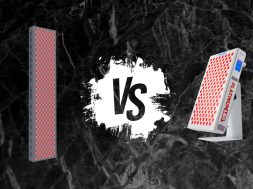







When people ask me about red light therapy on a spectrum from budget to premium, Hooga and Platinum LED are usually the two names that anchor either end. I have used both extensively and the performance gap is real.
Hooga HGPRO450 is the benchmark for affordable entry-level panels. Platinum LED BioMax 300 is one of the most technically sophisticated compact panels on the market.
Both do what they claim. But only one of them is worth your money if you are serious about recovery, skin, and long-term performance.
Quick Verdict
Platinum LED BioMax 300 is the clear winner over Hooga. Six wavelengths, extreme irradiance, and industrial build quality put it in a different performance class. The RLT Home TotalSpectrum Compact matches Platinum LED on wavelength count, adds 7-band coverage with verified data, and does it at a better price point for the spec level.
Quick Verdict
Platinum LED is an excellent device. Hooga is a solid budget starter. But if you want the most complete home red light therapy experience, the RLT Home TotalSpectrum Compact is still the better investment.
The TotalSpectrum Compact covers 630nm, 660nm, 810nm, 830nm, 850nm, 940nm, and 1070nm. It combines the wavelength depth of Platinum LED with verified output data and a more flexible design.
For athletes who want clinical-level results without overpaying for brand prestige, the RLT Home Compact is the answer.
What Is Platinum LED BioMax 300?
Platinum LED has been building red light therapy panels longer than most brands in this space. The BioMax series is their flagship line, built for serious home users who want clinical-grade performance.
The BioMax 300 uses six wavelengths: 630nm, 660nm, 810nm, 830nm, 850nm, and 1060nm. That 1060nm wavelength is rare and penetrates deeper than standard near-infrared,[1] reaching thick muscle groups and joints.
Irradiance is extremely high at clinical levels. The build is all-metal with high-velocity fans and a digital control panel. It is designed to run daily for years.
The BioMax 300 is modular. You can expand it into a full-body array by linking additional panels as your needs grow.
Pros
- Six wavelengths including the rare 1060nm deep-penetrating band
- Extreme irradiance output for short, effective sessions
- Industrial all-metal build designed for long-term use
- Modular: expandable into a full-body setup
- Digital controls with independent RED/NIR modes and timer
- Established brand with strong warranty and customer support
Cons
- Stationary device: requires you to stand still during sessions
- Premium price at around $659 for the compact 300 model
- Light spillage at distance reduces effective dose
- Requires eye protection during use
My Platinum LED BioMax review covers my full hands-on experience with this panel.
What Is Hooga?
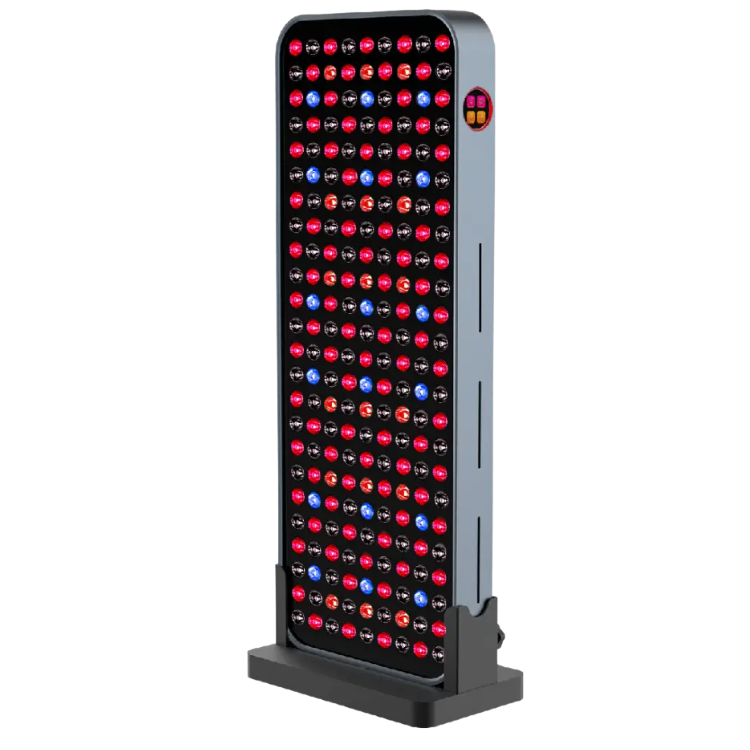
Hooga built their reputation by offering reasonably powered red light panels at a price point that most buyers can access. The HGPRO450 is their best current panel.
It runs 450 LEDs at 660nm and 850nm, with independently tested irradiance around 100 mW/cm² at two inches. The third-party verification is a genuine plus for a budget device.
Hooga is best suited for skin improvement and light wellness use. It is not designed for deep recovery or high-performance athletic applications.
The build is solid for home use at this price tier. Fan noise is moderate and the hanging kit is straightforward to set up.
Pros
- Published third-party irradiance testing
- Affordable at around $279
- Reliable for skin improvement and basic wellness
- Easy setup and wide availability
Cons
- Only two wavelengths: 660nm and 850nm
- Irradiance drops quickly with distance
- Not suitable for serious athletic recovery
- Budget build quality limits long-term durability
My Hooga review covers my full experience with this device.
Platinum LED vs Hooga: Main Differences
Wavelengths and Specs
Platinum LED BioMax 300 covers six wavelengths including 810nm and 830nm, which fill the gap between standard red and near-infrared for broader tissue coverage.[2] The 1060nm band is unique and adds deep tissue penetration that no budget panel offers.
Hooga covers 660nm and 850nm only. For skin goals these are adequate. For anything deeper, the two-wavelength limit is a real constraint.
Irradiance and Output
Platinum LED BioMax 300 delivers clinical-grade irradiance that allows effective sessions in 10 to 15 minutes at standard distances. The output is among the highest available in a compact home panel.
Hooga HGPRO450 delivers around 100 mW/cm² at two inches, which drops substantially at six inches. Effective sessions require staying very close to the panel.
Design and Build Quality
Platinum LED is all-metal construction with industrial cooling fans. It is built to last years of daily use and feels like professional equipment.
Hooga uses plastic housing that is functional but not built for heavy daily use over multiple years. It is adequate for the price, but you feel the difference holding both devices.
Third-Party Testing
Both brands publish irradiance data. Hooga uses third-party lab testing, which is commendable at its price point. Platinum LED’s published data is backed by its reputation and long track record in the space.
For performance athletes or clinical applications, Platinum LED’s documentation is more thorough. For casual home users, Hooga’s verification is sufficient.
User Reviews
Platinum LED reviews consistently report strong results for skin, recovery, and joint pain. Long-term users regularly note durability and consistent performance over years.
Hooga reviews are positive for skin improvement. Users focused on recovery or pain management report more mixed results, which aligns with the device’s lower irradiance at practical distances.
Price
| Product | Price | Best For |
|---|---|---|
| Platinum LED BioMax 300 | ~$659 | Clinical-grade skin and recovery work |
| Hooga HGPRO450 | ~$279 | Skin improvement, budget entry point |
| RLT Home TotalSpectrum Compact | Check current price | 7-band clinical-grade full coverage |
My Experience Using Platinum LED and Hooga
I ran the Platinum LED BioMax 300 for eight weeks on a mix of post-training recovery sessions and targeted knee work. Results were consistent and measurable: soreness cleared faster and my shoulder felt noticeably better after two weeks of daily use.
The Hooga HGPRO450 I used for four weeks primarily on facial skin and light torso sessions. Skin improvement was visible. For recovery, the results were modest compared to the Platinum LED at the same session duration.
The irradiance difference is real in practice, not just on spec sheets. The Platinum LED delivers a more effective dose faster.
If I had to pick between the two for a serious training athlete, Platinum LED is the clear choice. Hooga suits casual users with limited budgets.
Should You Buy Platinum LED or Hooga?
Platinum LED BioMax 300 is the right choice if you train hard and want a device that genuinely supports recovery and performance. The six-wavelength output and industrial build quality justify the price for serious users.
Hooga is the right choice if you are new to red light therapy, primarily focused on skin, and cannot stretch to $659. The third-party testing data is reassuring at that price point.
If you want the best combination of wavelength depth, verified output, and value, the RLT Home TotalSpectrum Compact outperforms both. Seven wavelengths, independent irradiance verification, and a design built for real athletes.
Our Top Pick
RLT Home TotalSpectrum Compact
7-Band Full Spectrum Panel
Seven verified wavelengths in a panel built for serious recovery. The TotalSpectrum Compact outperforms both Platinum LED and Hooga where it matters: depth, coverage, and verified output.
See Best PriceReferences
- Chung, H., Dai, T., Sharma, S. K., Huang, Y. Y., Carroll, J. D., & Hamblin, M. R. (2012). The nuts and bolts of low-level laser (light) therapy. Annals of Biomedical Engineering, 40(2), 516-533. https://pubmed.ncbi.nlm.nih.gov/22045511/
- Hamblin, M. R. (2017). Mechanisms and applications of the anti-inflammatory effects of photobiomodulation. AIMS Biophysics, 4(3), 337-361. https://pubmed.ncbi.nlm.nih.gov/28490312/
- Leal-Junior, E. C., Vanin, A. A., Miranda, E. F., de Carvalho, P. D., Dal Corso, S., & Bjordal, J. M. (2015). Effect of phototherapy on exercise performance and markers of exercise recovery. Lasers in Medical Science, 30(2), 925-939. https://pubmed.ncbi.nlm.nih.gov/25826620/
